Digital future
Digital wisdom applied to decades of hard-won operational experience. Flow, pull, kaizen, respect for people. The most proven system we have for closing the gap between the current way and the better way.
Practical Steps to Bridging the Digital Divide, and Building the Future of Manufacturing Operations

Augmented Lean approached frontline operations historically and conceptually. It was written for organizational leaders and a general readership, and it named the challenges honestly — but it was light on specifics. Readers finished it convinced, and then asked the obvious next question.
This is the answer. Grounded in practitioners’ experiences and supported by real-world case studies, it offers step-by-step playbooks for the people who actually do the work. The book focuses on presenting composability as the method for identification and execution: recognizing the opportunity in front of you and matching it to a concrete plan.
“The investment went into the tool, and the method the tool was meant to serve was never examined. Throwing technology at a problem this way digitizes Lean Theatrics.”
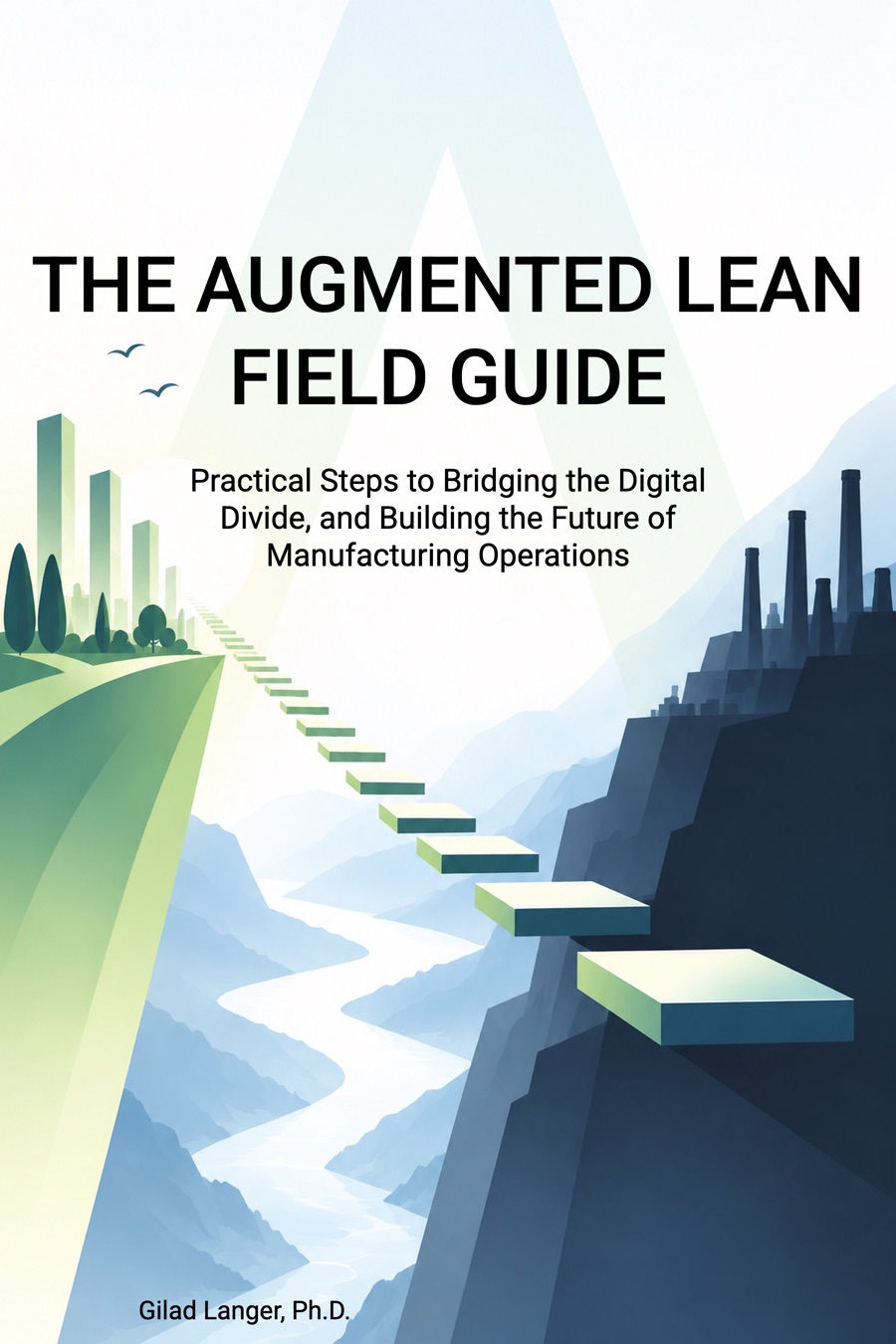
The cover is an argument, not a decoration.
Digital wisdom applied to decades of hard-won operational experience. Flow, pull, kaizen, respect for people. The most proven system we have for closing the gap between the current way and the better way.
Real plants, real constraints, real legacy systems. Capable and hard-edged, but built on architecture that resist changes and hinder innovation.
Not a leap. Not technologies dropped in from above. A journey of deliberate, load-bearing steps — each narrow enough to carry weight, each close enough to reach the next.
Lean has reached a ceiling. Augmented Lean breaks through it.
Lean’s methods were built to improve what people can see and record by hand. Operations that practice Lean reach the limit of that evidence. The improvements are hidden in manual work no system captures, and in variation that moves faster than a paper-based Kaizen cycle can follow. Augmented Lean takes the operation past that ceiling with the technologies of the digital age and AI as their foundation. It applies these technologies in service of the people doing the work.
Crossing the digital divide takes a method as deliberate as Lean itself. An organization that buys digital tools without changing how it improves will not see success. Augmented Lean builds on Lean’s principles and practices and applies digital tools to produce the step change. It builds a methodical approach to improvement in a digital first environment with Kaizen cycles and a capacity that compounds across use-cases and sites. It also prepares the operation for the rapidly evolving technological landscape, building a composable operation that is poised to adopt new technologies as they arrive.
A composable operating model has five key pillars and solution that are composable move operational improvement forward. Miss any one of them and the solution will anchor you in the monolithic constraints.
Solutions are built from the operational level up, tailored to specific processes and operator contexts — not imposed through top-down hierarchies. The people closest to the problem contribute to the system's development.
The reunion of lean and agile: rapid test-fail-learn cycles and on-demand process changes. Not a development methodology — an operational property. The floor responds in hours to days, not weeks to months.
Engineers, technicians, and operators closest to the work create and maintain apps without deep IT expertise. When the people who know the process best build the solution, it is more accurate and more readily adopted.
Technology serves the operator, not the reverse. Solutions are crafted for a specific operator context. Productivity gains follow from augmenting human capability rather than forcing humans to adapt to system constraints.
Seamless digital compliance that is built in, compliance is the result of quality. This is the adoption of risk based and continuous validation principles. Digital solutions continuously improved while maintaining a validated state, rather than locked down between re-validation cycles.
Digital Maturity — the organization ability and readiness for digital transformation. Can it actually sustain and scale what the Pillars enable. Master the Pillars without the governance, readiness, or infrastructure to support them and you cap out early.
Connectivity & Data Integrity — accurate, timely, and trustworthy operational data connected and at the point of work. Without it the digital capabilities are not working from the reality, the intelligence layer is blind, and the operator is not augmented.
AI and digital tools amplify the quality of the operation they run on. The Lean depth assessment in Chapter One measures practice in daily behavior across five signals. It is not a pass/fail gate; it is a map of where augmentation will amplify real practice and where it first has to build practice to amplify.
The opening chapter resets the lean lens — what lean actually is, what gets lost when it is diluted, and the honest assessment that has to come before any augmentation work begins. Yours to read now, ahead of publication.