The CI engineer
Handed “figure out digital” as a side project, on top of the improvement work already owned.
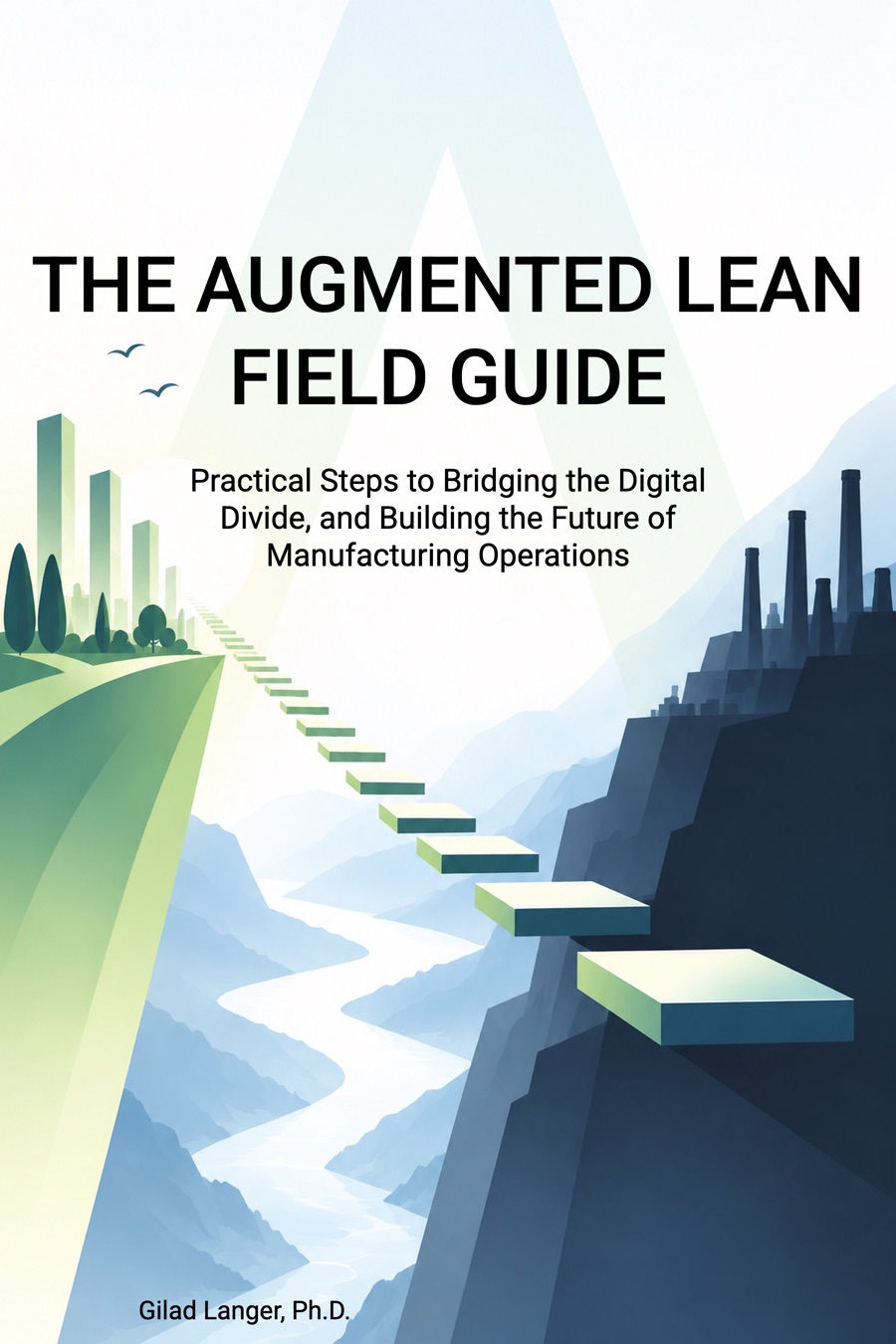
Fifteen chapters across four sections — from resetting the lean lens, through picking and deploying a first use-case, to scaling across a network of sites.
This is not written to a single persona. Different kinds of reader need different depths of the same material — not different books.
Handed “figure out digital” as a side project, on top of the improvement work already owned.
Governing citizen development across sites — enough autonomy to move, enough control to stay sane.
The people who live with the result long after the project team has moved on.
Read Augmented Lean, convinced of the why, now needs a practical path for the organization.
Chapters lead with the concrete situation before the abstraction. Every chapter anchors its argument in a real customer example — organizations that got it right, and some that did not. Recommendation that are rooted in the real-world application of Lean principles. Patterns that provide practical insight into how to apply these principles in the digital age. And tools to use to bring change to your organization.
What Do We Talk About When We Talk About Lean? It opens on a Kaizen event that does everything right and still misses the root cause, revisits the Toyota Production System as a pragmatic answer to manufacturing complexity, names the Lean Theatrics that follow when the tools arrive without the method, and closes with the Lean depth assessment to run before augmentation starts amplifying your practice.
Each section builds on the last — from the argument that lean and augmentation are complementary, through the implementation playbook, to what it takes to scale beyond a single line.
What Lean is as a system, why TPS works on the inherent variability of manufacturing, and how to tell deep Lean practice from its visible artifacts. Introduces the waste of not having digital data and the Lean depth assessment, and sets the vocabulary the rest of the book relies on. Read it now →
People are the most valuable asset, work is getting more complex, agility has replaced flexibility as the strategic advantage, and monolithic systems cannot move fast enough to stay competitive or resilient.
Shows how time-to-change is where Lean and augmentation meet, with augmentation extending Lean's reach and Lean keeping augmentation anchored to customer value. Introduces the Monolithic Trap that later chapters build on.
What augmentation actually demands of an operation — decentralized teams, empowered workers, citizen development, and more complexity both within and across sites. Names the size of the prize and the size of the risk.
The overview, worked backward from a mature deployment to show what it took to get there. Where the 5 Pillars of Composability get their first formal definition, alongside starting bottom-up and prioritizing high-impact use-cases.
The Business Objectives Framework and the gemba-first assessment — marrying business value, operator activity, physical requirements, and business process. Introduces the disposable diagnostic app as a way to test a use-case before committing to it.
Sprint structure, the Minimum Viable Solution pattern, and the feedback and triage cycle. Names three recurring pitfalls — Waterfall Reversion, Centralized Authorship, Governance Before Value — plus the Diagnostic Test for telling a genuinely composable deployment from an agile-flavored waterfall one.
The five roles a first use-case needs — operator, process owner, approver, builder, sponsor — against the Creation, Curation, Composition, Consumption framework. Opens the book's change-agent thread: the difference between a sponsor who backs the work and a change agent who does it.
The solution design method in full: the three perspectives, the Operational Flow Diagram, and the Solution Credo. Home to the full definition of Connectivity and Data Integrity, and to the Composable Agentic Framework with its builder and staff agents.
People, process, governance, and cross-organizational alignment for moving past a first use-case. The Digital Maturity Model, the Explore, Scale, and Transform phases, and Escape Velocity — the point where a deployment no longer needs central pushing.
IT and OT convergence, and the Lone Wolf pitfall — governance as the difference between a citizen developer program and shadow IT, told through a deployment that scaled and one where a brilliant unsupervised developer became a single point of failure.
Site assessment methodology and peer learning for maturing a single site's digital profile — including the criteria for calling a site self-sustaining.
Centralizing learning, training, and repeatable use-cases across a network: global and local governance, Center of Excellence models, and standardizing components rather than whole solutions so sites can customize the surface while the underlying logic stays consistent.
The value tracking framework — how to show what the work actually returned, and to whom.
Deployments followed end to end — organizations that got it right, and at least one that did not — each closing with the generalizable lesson rather than the highlight reel.
Chapter titles and scope reflect the working manuscript and may change before publication.
Augmented Lean made the case: put humans at the center, build for agility, stop forcing the work to fit the system. The Field Guide is what comes next.
“An important book. Despite a generation of top-down tech investment, productivity is in decline, supply chains have failed, and our workforce is disenchanted. The next generation of tools must liberate the workforce to be faster and more flexible.”